An account-based marketing strategy starts from a defined list of companies you want as customers, then points marketing and sales at those accounts together, with messages built for each account or group of accounts. Instead of attracting as many leads as possible and filtering them later, you pick the accounts first and work outward to the people inside them.
To build one, you need five parts: a way to choose and tier accounts, a map of the buying committee at each account, data you can trust about both, plays that match each tier, and measurement at the account level instead of the lead level. This guide walks through each part, with fictional examples, the work involved and what tends to go wrong.
What account-based marketing is, and how it differs from lead-based marketing
Most B2B marketing is lead-based. You publish content, run ads and collect form fills, then score the leads and pass the good ones to sales. The unit is the person who raised a hand.
Account-based marketing (ABM) flips the order. The unit is the company. You decide which companies are worth winning, then reach several people at each one, because B2B purchases are usually decided by a group, not one person.
| Lead-based | Account-based | |
|---|---|---|
| Starting point | Anyone who shows interest | A named list of target companies |
| Unit of work | The individual lead | The account and its buying committee |
| Message | Broad, by persona | Specific to the account or a small cluster |
| Who owns it | Marketing hands off to sales | Marketing and sales plan it together |
| What you measure | Leads, MQLs, cost per lead | Account coverage, engagement, pipeline from target accounts |
The two are not exclusive. Many teams run inbound for the broad market and ABM for the accounts that matter most.
When ABM fits, and when it does not
ABM costs more per account than broad marketing, so it pays off when each account is worth that extra effort. It tends to fit when:
- Your deal sizes are large enough that winning one account justifies research and tailored outreach.
- Your market is finite. You can name most of the companies that could buy from you.
- Several people take part in the buying decision, so reaching one contact is rarely enough.
- Sales cycles are long and you need to stay present across months, not one email.
It fits less well when you sell a low-priced product with a short, self-serve cycle to a very large market. There, the time spent researching each account costs more than the deal is worth, and broad inbound or high-volume outbound usually works better.
A practical test: if you can write down the 50 companies you most want as customers and explain why, you have the start of an ABM program. If you cannot, fix your targeting first.
Step 1: choose and tier your target accounts
Account selection is where most ABM programs succeed or fail. A list built from gut feel or a few logos the CEO likes will waste every step after it.
- Write your ideal customer profile. Use firmographics (industry, headcount band, region), technology, business model and the situations that make your product urgent. If you do not have one yet, start with how to create an ideal customer profile.
- Look at your best customers. Find what your fastest, largest and happiest deals have in common. Those traits beat assumptions.
- Pull matching accounts. Search for companies that fit the profile, then add lookalikes of your best customers.
- Add timing signals. Hiring for roles tied to your product, a new leader in the buying function, a funding round or a new product line. Hiring is one of the easiest to observe, and it overlaps with what B2B intent data is: evidence an account may be in market now.
- Tier the list. Sort by fit and timing, then assign each account to a tier based on how much effort you can afford.
| Tier | Approach | Accounts | Personalization | Typical plays |
|---|---|---|---|---|
| Tier 1 | One-to-one | A handful you can research by hand | Per account | Custom research, executive outreach, tailored content |
| Tier 2 | One-to-few | Small clusters sharing an industry or problem | Per cluster | Cluster-specific messaging, role-based sequences |
| Tier 3 | One-to-many | A larger list that fits the profile | Per segment | Targeted ads, signal-triggered emails |
Keep each account's tier and the reason for it in your CRM, so anyone can see why it is on the list. A fictional example of what that record might hold:
{
  "account": "Northwind Analytics",
  "domain": "northwind.co",
  "tier": 1,
  "fit_reasons": ["B2B SaaS", "50-200 employees", "US"],
  "timing_signals": ["Hiring SDRs", "Hiring RevOps Manager"],
  "owner": "AE + marketing pod",
  "reviewed": "monthly"
}
Fictional example record.
Review tiers on a schedule. Accounts move: a Tier 3 company that starts hiring for the exact problem you solve may deserve Tier 1 attention this month.
Step 2: map the buying committee
Once you know the account, you need the people. Selling to one contact is fragile: they can leave, lose the internal argument or never reply. Mapping the buying committee means finding the roles that shape the decision and planning to reach several of them.
Common roles to look for:
- Economic buyer: owns the budget and signs off. Often a VP or C-level leader.
- Champion: feels the problem day to day and wants it fixed. Often a manager or director.
- Users: the people who will work in your product.
- Technical evaluator: checks security, integrations and fit with the current stack.
- Procurement or legal: handles contracts and vendor reviews.
- Possible blockers: owners of a competing project or tool.
For each Tier 1 and Tier 2 account, list the names you have, the roles you are missing and the angle each role cares about. A champion at Stackfold (a fictional example) might care about time saved this quarter; their CFO cares about cost and risk. The same product, two different messages.
Be realistic about what you can know. Titles and departments are observable. Who actually holds influence usually comes from conversations, so update the map as sales learns more.
Step 3: get the account and contact data right
ABM depends on data more than broad marketing does, because every mistake lands on an account you specifically chose. Wrong headcount puts an account in the wrong tier. An outdated title sends your tailored message to someone who left. A guessed email bounces and hurts your sender reputation.
What you need per account and per contact:
- Firmographics: industry, headcount band, location, technology.
- Signals: open roles, leadership changes, what the company says on its own site.
- People: name, current title, seniority, function.
- Contact data: a work email with an honest verification status, not just a guess.
- Freshness: when each fact was last checked, so you know what to trust.
This is the job of data enrichment: taking a domain or a name and filling in the fields you are missing. Check dates matter as much as the fields. People change jobs, and a list that was accurate in spring may not be in autumn.
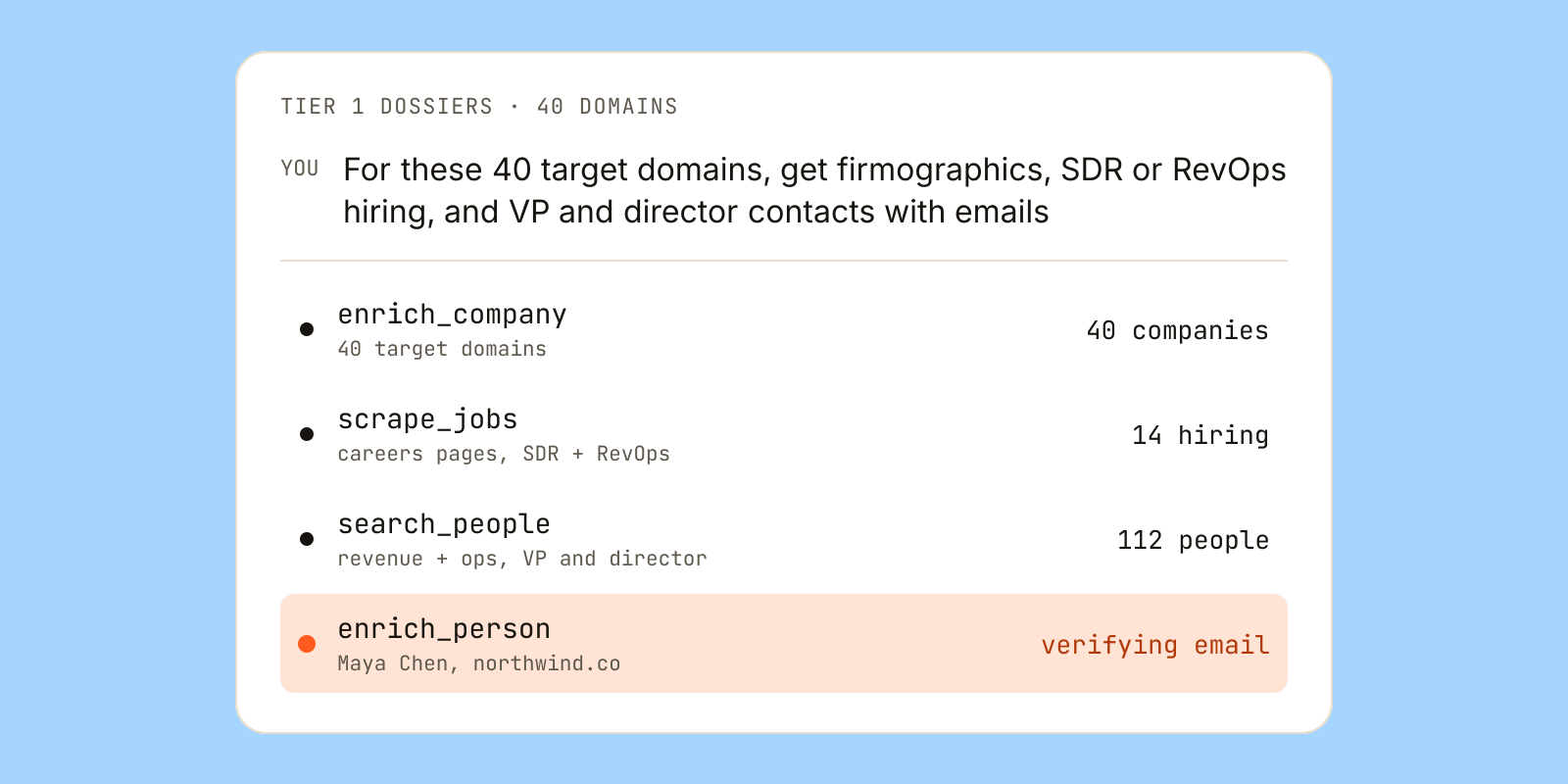
If you want an AI agent to do this research, Leadsets gives agents B2B data tools over a remote MCP server and a REST API. You describe the job in plain language and the agent calls tools such as enrich_company, scrape_jobs, search_people and enrich_person. A prompt for building Tier 1 dossiers might look like this:
Take these 40 target domains. For each one, give me the headcount band
and industry, whether they are hiring SDRs or RevOps right now, and the
VP-level and director-level people in revenue and operations with
verified work emails. Put catch-all addresses in a separate column.
The agent would run roughly this sequence:
enrich_companyon each domain for firmographics, with source and checked date on every field.scrape_jobson each careers page for open roles with titles and dates.search_peoplefiltered bycompany_domain, function and seniority, with match reasons on each result.enrich_personon the people you keep, which returns a work email already verified and labelled verified, catch-all, unknown or invalid.
What it costs: paid plans are a flat monthly price from $29 (Solo) with fair-use limits instead of credits, and the free plan gives 1,000 records once with no card. Scraping careers pages is an add-on on paid plans, billed at one unit per page, and is not on the free plan. Records only count when data comes back. What can go wrong: some domains are catch-all, so no one can confirm the mailbox, and some roles simply have no verified email. Treat those as lower confidence instead of sending at full volume.
Step 4: run plays that match each tier
A play is a planned set of touches aimed at an account or cluster, with a clear trigger and owner. Match the effort to the tier.
Tier 1 plays
- Write a short research brief per account: what they sell, who they sell to, what changed recently.
- Reach the champion and the economic buyer with different messages tied to the same problem.
- Create one piece of content for the account, such as a teardown of their current process or a tailored business case.
- Coordinate timing: marketing warms the account with targeted ads while sales starts outreach.
Tier 2 plays
- Group accounts that share an industry or problem (for example, fictional logistics companies like Parcelry that are hiring operations staff).
- Write one message per role per cluster, with a specific opening line per person.
- Use a shared landing page or case study that speaks to that cluster.
Tier 3 plays
- Run ads to the account list.
- Trigger emails from signals: a new SDR job post, a new sales leader.
- Move accounts up a tier when they engage or a strong signal appears.
Email outreach is part of most plays, so the basics of outbound sales still apply: a clear reason to reach out, a short message and a verified list. You are also responsible for the outreach laws that apply to you, such as CAN-SPAM, GDPR and CASL, and for honouring unsubscribes.
If your team uses an agent, free playbooks such as buying committee mapper, account tiering, account research brief and new leader alerts are in the list of open-source GTM skills. They tell the agent which tools to call and how to check the result.
Step 5: measure at the account level
Lead-based metrics hide what ABM is doing. One target account might produce zero form fills and still turn into your largest deal of the year. Measure the accounts instead.
| Metric | What it tells you | How to track it |
|---|---|---|
| Coverage | Do you know the right people at each account? | Committee roles mapped and contacts with a verified email, per account |
| Engagement | Is the account paying attention? | Replies, meetings, site visits and content views, rolled up to the account |
| Meetings | Are you getting into the room? | Meetings with target accounts, by tier |
| Pipeline | Is ABM creating real opportunities? | Opportunity value from target accounts versus the rest |
| Win rate and deal size | Are these better deals? | Compare target accounts with non-target deals over the same period |
| Velocity | Do deals move faster? | Days from first meeting to close, by tier |
This only works if the account tier, the committee roles and the activity live in one place, usually your CRM. Tag each account with its tier on day one, so you can compare cohorts later. If you run HubSpot, an agent can backfill missing emails and fill empty company fields with HubSpot data enrichment through Leadsets, which keeps coverage numbers honest.
Give it time. ABM targets longer sales cycles, so judge pipeline and win rates over a quarter or more, and use coverage and engagement as the early read.
Common mistakes to avoid
- Too many Tier 1 accounts. If you cannot research each one by hand, it is not Tier 1.
- A list built on opinion. Base selection on your profile, your best customers and observable signals.
- Single-threading. One contact per account is a bet on one person staying, replying and winning internally.
- Stale data. Titles and employers change. Re-check contacts before each campaign, not once a year.
- Treating uncertain emails as valid. Catch-all and unknown addresses are not confirmed. Send to them at lower volume or find another route.
- Sales and marketing working from different lists. Agree on the accounts, tiers and plays together, then review them together.
- Judging ABM by MQLs. Use account-level metrics, or the program will look like it is failing while it builds pipeline.
Start small: one tier, a short list of accounts and one play per tier. Measure coverage and engagement for a few weeks, fix the data gaps you find, then widen the list.
Questions and answers
What is an account-based marketing strategy?
It is a B2B approach where you pick a named list of target companies and point marketing and sales at them together, with messages built for each account or small group of accounts. You reach several people in each buying committee instead of waiting for individual leads to raise their hands.
How is ABM different from inbound or lead generation?
Lead generation starts with anyone who shows interest and filters them later, so the unit is the individual lead. ABM starts with the companies you want to win and works outward to the people inside them, so the unit is the account. Many teams run both: inbound for the broad market and ABM for their highest-value accounts.
How many accounts should an ABM program target?
It depends on how much research and outreach your team can do well. Keep Tier 1 small enough that someone can research every account by hand, put larger clusters in Tier 2, and use Tier 3 for the wider list that fits your profile. Start smaller than you think and expand once the plays work.
What data do you need for account-based marketing?
You need firmographics such as industry, headcount band and location, timing signals such as hiring or leadership changes, and the right people at each account with current titles. You also need work emails with an honest verification status and a date showing when each fact was last checked, because stale or guessed data hurts targeted outreach more than broad campaigns.
How do you measure ABM success?
Measure accounts, not leads: coverage of the buying committee, engagement rolled up to the account, meetings, pipeline from target accounts, win rate, deal size and sales cycle length. Compare target accounts with non-target deals over the same period, and give the program at least a quarter because ABM deals tend to take longer.
Is account-based marketing only for enterprise companies?
No. Smaller teams can run ABM if their deals are large enough to justify the research and their market has a nameable set of buyers. It fits less well for low-priced, self-serve products sold to a very large market, where broad inbound or high-volume outbound is usually more efficient.
Go deeper
- Web scrapingWhat a company sells and who it sells to
- How our data is madeFirmographics with source and freshness
- IntegrationsHubSpot, Salesforce, Clay, n8n and more